Honey from Algeria
Earth chestnut honey
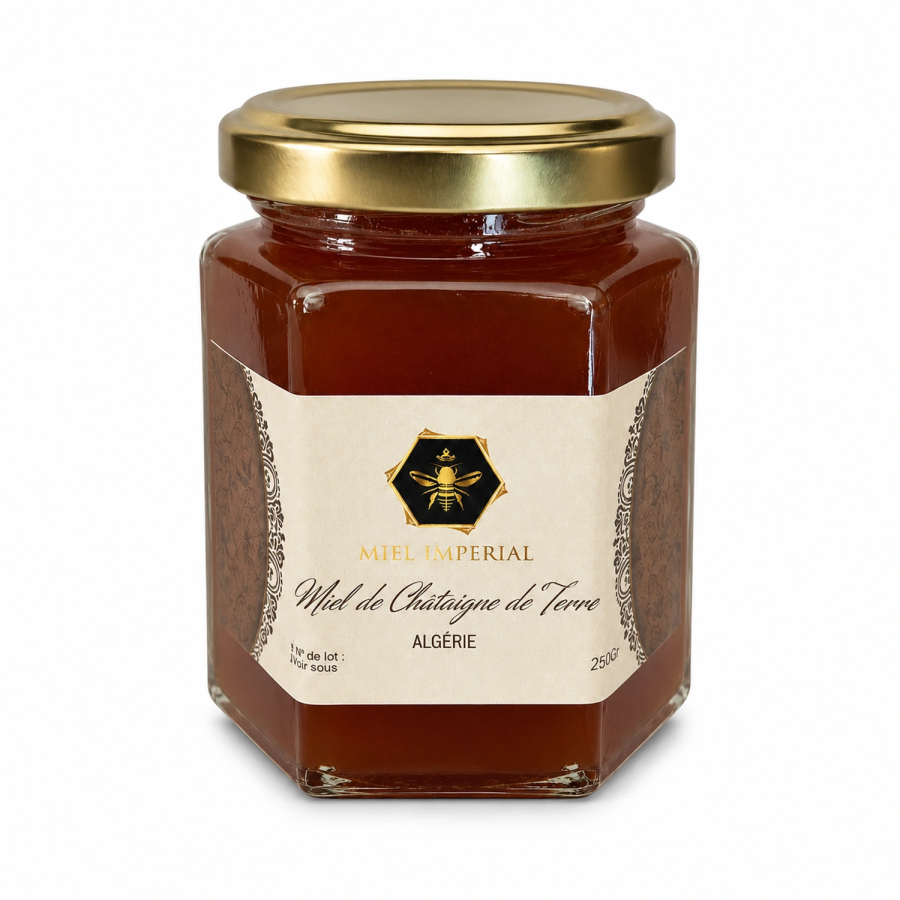
There is no tree and no spiny husk behind earth chestnut honey: the earth chestnut is a small white-flowered plant of the carrot family (Apiaceae) whose tuber grows underground. This honey from Algeria has an amber colour with copper highlights and comes in a 250 g glass jar.
Earth chestnut honey from Algeria: the plant, the name, the jar
Plant
Genus Bunium
Carrot family (Apiaceae)
In Algeria
Talghouda
التالغودة, Bunium mauritanicum
Flowers
White umbels
June to July in B. bulbocastanum
Jar
250 g
Hexagonal glass, gold lid
The name comes from the plant's tuber, also known as earthnut or great pignut. The bees, for their part, only care about the flowers.
Earth chestnut or chestnut tree: two different honeys
Chestnut honey comes from a tree, the sweet chestnut (Castanea sativa). The earth chestnut is a herbaceous plant from a completely different family, that of carrot and fennel. The two honeys share nothing but the word "chestnut".
Talghouda, the earth chestnut of the high plateaus
In Algeria, the name talghouda (التالغودة) refers to Bunium mauritanicum, a species of the same genus. A thesis from the University of El Oued studied it using plants collected in the wilayas of Oum El Bouaghi, Souk Ahras, El Bayadh and Bordj Bou Arreridj, on the high plateaus.
Its relative Bunium bulbocastanum is called châtaigne de terre or noix de terre in French. Its white umbels open in June and July, and its natural range runs from Western Europe to North Africa.
At the table
Enjoy it on its own by the spoonful, on toast, with fresh goat's cheese or in yoghurt. It also goes very well with a warm flatbread at breakfast.
From the same plant family, our wild carrot honey also comes from the umbels of a member of the carrot family: a good way to compare two related honeys.
Storage
Close the jar tightly after use and keep it at room temperature, away from light and moisture. If it crystallises, that is natural: a warm water bath will make it runny again.
Our honeys from Algeria
Find this jar and its neighbours among our Algerian honeys, all in 250 g glass jars.
Good to know: honey should not be given to children under one year old, whatever its origin. This is the recommendation of Anses, the French food safety agency.
Frequently asked questions about earth chestnut honey
Earth chestnut honey and chestnut honey: what is the difference?
They are not the same plants. The sweet chestnut is a tree, while the earth chestnut is a small herbaceous plant of the genus Bunium, in the carrot family. The names are similar, the flowers are not.
What is the earth chestnut?
A plant of the genus Bunium with white flowers in umbels. It owes its name to its underground tuber.
What does talghouda mean?
It is the Algerian name (التالغودة) for Bunium mauritanicum, an earth chestnut that grows on the high plateaus.
Where does this earth chestnut honey come from?
From Algeria, as stated on its label.
How should I store this honey?
Lid closed, at room temperature, away from light and moisture. Crystallisation is normal.
Sources and method
Written by the Miel Impérial team from the jar label and the sources listed above. Updated: November 2026.