Honey from Algeria
Wild carrot honey
Carrot honey does not come from the orange root you peel. Bees gather it from the large white flower umbels of wild carrot (Daucus carota), a plant of verges and waste ground. This one was harvested in Algeria, where the Ministry of Agriculture counts wild carrot among the country's honey varieties.
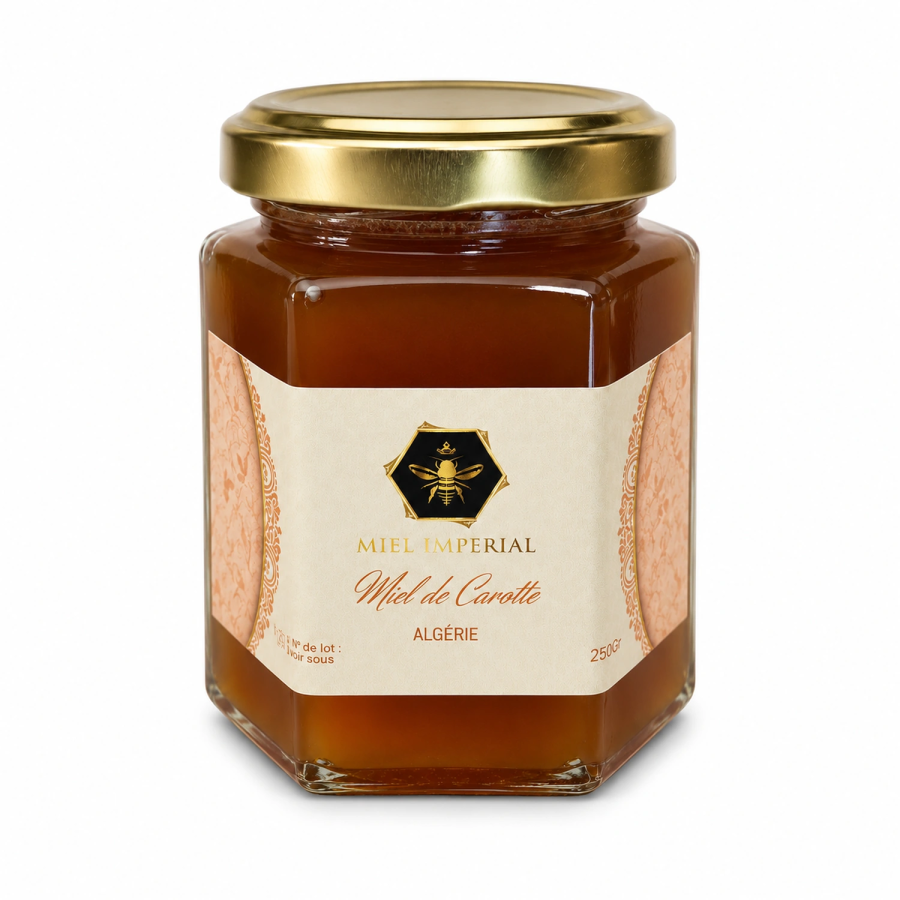
Miel Impérial wild carrot honey, from umbel to jar
• Wild carrot honey, from the flowers of Daucus carota, a plant of the carrot family (Apiaceae).
• Origin: Algeria. The Algerian Ministry of Agriculture lists wild carrot honey among the thirteen honey varieties produced in the country.
• Amber colour with orange highlights, in a 250 g hexagonal glass jar with a gold lid.
• The name refers to the flower the bees visited: the jar contains nothing but honey.
Plant
Daucus carota
Carrot family (Apiaceae)
In Arabic
Djazar barri
جزر بري, "wild carrot"
Flowering
June to late summer
Flowering period of the plant
Size
250 g
Hexagonal glass jar
How is carrot honey made?
Like every honey named after a flower, it comes from the nectar bees collect mainly from one plant, here wild carrot. They carry it back to the hive, where it turns into honey in the wax cells before the harvest.
The plant is easy to spot: its small white flowers crowd into flat umbels on 20 to 40 rays, and a tiny dark red or purple flower sometimes appears in the centre. Everything starts with these umbels, not with the root.
Wild carrot, a Mediterranean plant
Found in temperate and warm regions, especially around the Mediterranean, wild carrot flowers from June to the end of summer. In Arabic it is called djazar barri. In Algeria, the Ministry of Agriculture includes it among the country's honeys, alongside jujube, spurge, thyme and thistle.
Among those honeys, the Algerian news site TSA describes jujube honey as probably the most popular in Algeria: that is our jujube honey from Algeria, harvested in the Laghouat region.
Every day
Enjoy it by the spoonful, on a slice of bread, in plain yoghurt or with fresh cheese. In tea, stir it in once the cup has cooled a little.
Want to compare two honeys from the same plant family? Our earth chestnut honey also comes from a member of the carrot family, a small tuberous plant of the high plateaus.
Storage
Keep the jar tightly closed at room temperature, away from light and moisture. Over time, honey may crystallise: this is a natural process. A few minutes in a warm water bath will make it runny again.
Our honeys from Algeria
This jar belongs to our Algerian honeys: five honeys from the country's plants, each in a 250 g glass jar.
Good to know: honey should not be given to children under one year old, whatever its origin. This is the recommendation of Anses, the French food safety agency.
Carrot honey: your questions
Is carrot honey made from carrots?
No. The name refers to the plant whose flowers the bees visited, wild carrot (Daucus carota). There is no vegetable or juice in the jar, only honey.
Where does this wild carrot honey come from?
From Algeria, as stated on its label. The Algerian Ministry of Agriculture lists wild carrot honey among the thirteen honey varieties produced in the country.
What colour is wild carrot honey?
This one is amber with orange highlights, clearly visible through the glass.
What is wild carrot called in Arabic?
Djazar barri (جزر بري).
How should I store carrot honey?
At room temperature, lid closed, away from light and moisture. If it crystallises, a warm water bath makes it runny again.
How much honey is in the jar?
250 g of honey, in a hexagonal glass jar with a gold lid.
Sources and method
Written by the Miel Impérial team from the jar label and the sources listed above. Updated: November 2026.