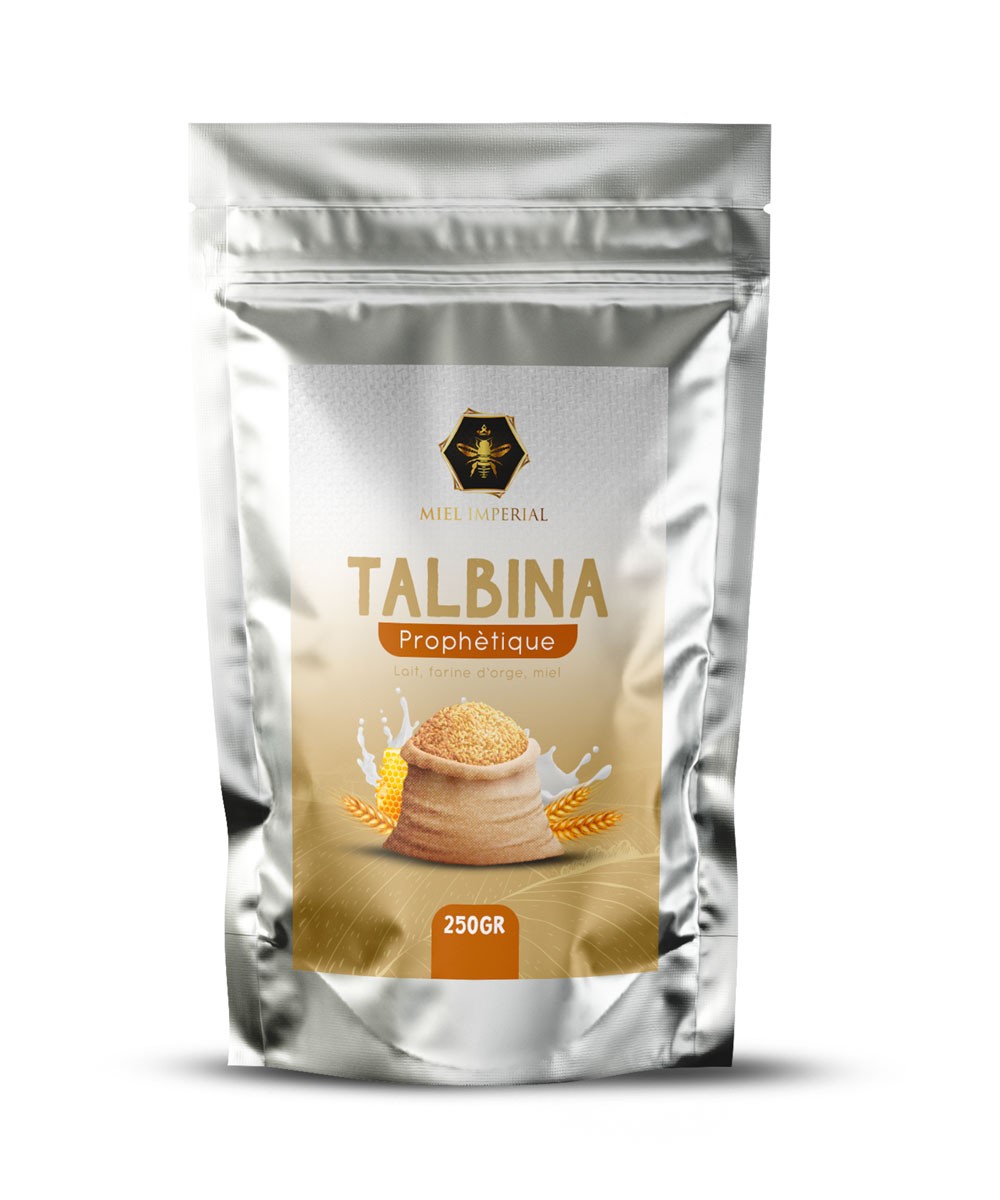
A Miel Impérial Selection
Natural Prophetic Talbina - Barley Flour 250 g or 500 g
Talbina is an age-old preparation of the Arab-Muslim world: a barley flour porridge cooked in milk or water, often sweetened with honey. Its name comes from laban, milk in Arabic, because of its consistency and whiteness once prepared. Miel Impérial offers the natural barley flour used to make it, in a 250 g or 500 g bag.
Miel Impérial Talbina: barley flour in 250 g and 500 g
• Miel Impérial talbina is a natural barley flour, intended for making the traditional porridge of the same name, in a 250 g or 500 g bag.
• Talbina is prepared by mixing the flour into milk or water, then cooking it gently until a smooth porridge forms.
• Its name comes from the Arabic word laban, meaning milk, in reference to its white, milky appearance once cooked.
• It holds a notable place in the culinary heritage of the Arab-Muslim world and in the corpus of prophetic medicine.
• Barley contains gluten: this preparation is not recommended for people with coeliac disease or gluten intolerance.
250 g or 500 g
two bag sizes
Barley flour
natural, no additives
Age-old recipe
from the Arab-Muslim world
Ready to cook
porridge in minutes
What is talbina?
Talbina refers both to the preparation and to the resulting dish: a barley flour porridge, cooked gently in milk or water until smooth. It is traditionally sweetened with honey, and depending on the household dates, cinnamon or a little butter are added.
The word comes from the Arabic laban, meaning milk: once cooked, talbina indeed takes on a white colour and a consistency recalling milk. It is a simple, comforting dish, the kind that has been made for centuries with next to nothing.
Barley, a cereal of the origins
Barley (Hordeum vulgare) is one of the oldest cereals cultivated by humans. Domesticated in the Near East millennia ago, it fed the Mesopotamian, Egyptian and Mediterranean civilisations long before wheat took over.
In the Arab-Muslim world it holds a particular place: talbina is among the preparations of the prophetic medicine corpus, alongside other traditional foods such as honey, black seed or dates. It is this heritage that explains the enduring place of the dish in households.
How to prepare talbina
The base
Mix one to two tablespoons of barley flour into a bowl of cold milk or water, stirring well to avoid lumps. Adjust to the consistency you want.
The cooking
Bring to a low heat and cook for a few minutes, stirring constantly, until the mixture thickens. The porridge should stay flowing, not stiff.
The honey
Sweeten off the heat, once the preparation has cooled slightly, so as not to heat the honey. It is the traditional pairing par excellence.
The variations
Chopped dates, cinnamon, orange blossom water, crushed almonds, a knob of butter: every family has its version. Serve hot, at breakfast or at the end of the day.
Choosing your size
The 250 g bag suits discovering talbina or occasional use. The 500 g bag is for households that make it regularly, particularly during the month of Ramadan when it often returns to the table. In both cases the flour keeps for several months if it stays dry.
The world of prophetic medicine
Talbina is among the great classics of this heritage. Browse our full prophetic medicine section.
Precautions
• Contains gluten: barley is a gluten-containing cereal. This product is not recommended for people with coeliac disease or gluten intolerance.
• May contain traces of other cereals depending on production conditions.
• If you have a known allergy to cereals, ask your doctor for advice before consuming it.
• This product is a food flour. It replaces neither a varied, balanced diet, nor medical treatment, nor the advice of a healthcare professional.
Storage
Keep the flour dry, bag tightly closed or in an airtight jar, away from light, heat and humidity. Like any flour, it is sensitive to moisture, which makes it clump. Keep out of reach of young children.
FAQ - Talbina and barley flour
What is talbina?
It is a barley flour porridge cooked in milk or water, traditionally sweetened with honey. The word comes from the Arabic laban, milk, because of its white, milky appearance once prepared.
How do you prepare talbina?
Mix one to two tablespoons of barley flour into a bowl of cold milk or water, then cook over low heat for a few minutes, stirring, until it thickens. Sweeten with honey off the heat.
What goes with talbina?
Honey is the traditional accompaniment. Depending on the household, dates, cinnamon, orange blossom water, crushed almonds or a knob of butter are also added.
Does talbina contain gluten?
Yes. Barley is a gluten-containing cereal, so this preparation is not recommended for people with coeliac disease or gluten intolerance.
When is talbina eaten?
Traditionally at breakfast or at the end of the day. It appears particularly often on tables during the month of Ramadan.
250 g or 500 g: which size to choose?
The 250 g bag to discover it or for occasional use, the 500 g bag for households that make it regularly.
How should barley flour be stored?
Dry, bag tightly closed or in an airtight jar, away from light and humidity. Like any flour, it clumps on contact with moisture.
The porridge of the origins, made at home
Talbina · natural barley flour · 250 g or 500 g bag. A Miel Impérial selection.