

How to Host a Honey Tasting at Home

Turn four jars into a true sensory experience. This guide explains how to select, serve and compare honeys at home, without confusing colour or texture with quality.
THE MIEL IMPÉRIAL TASTING GUIDE · Updated 21 October 2026
Hosting a honey tasting at home is an easy way to compare origins, colours, textures and aromas with a clear method. This guide explains how to choose four contrasting profiles, prepare the table and complete a practical sensory scorecard.
Your tasting in four simple rules
- Choose four honeys that are genuinely different.
- Serve at room temperature, from the mildest to the most intense.
- Use a clean spoon for every jar and cleanse the palate between samples.
- Score appearance, aroma, texture, flavour and finish separately.
In this guide
How do you prepare a honey tasting?
Prepare four jars, one clean spoon per honey, room-temperature water, lightly salted white bread and one scorecard per guest. Avoid coffee, mint, tobacco and spicy food for an hour beforehand.
The right temperature
Bring the jars to room temperature in advance. Honey that is too cold feels firmer and releases less aroma. Do not heat it for the session: every sample should be compared under the same conditions.
Which honeys create the best contrast?
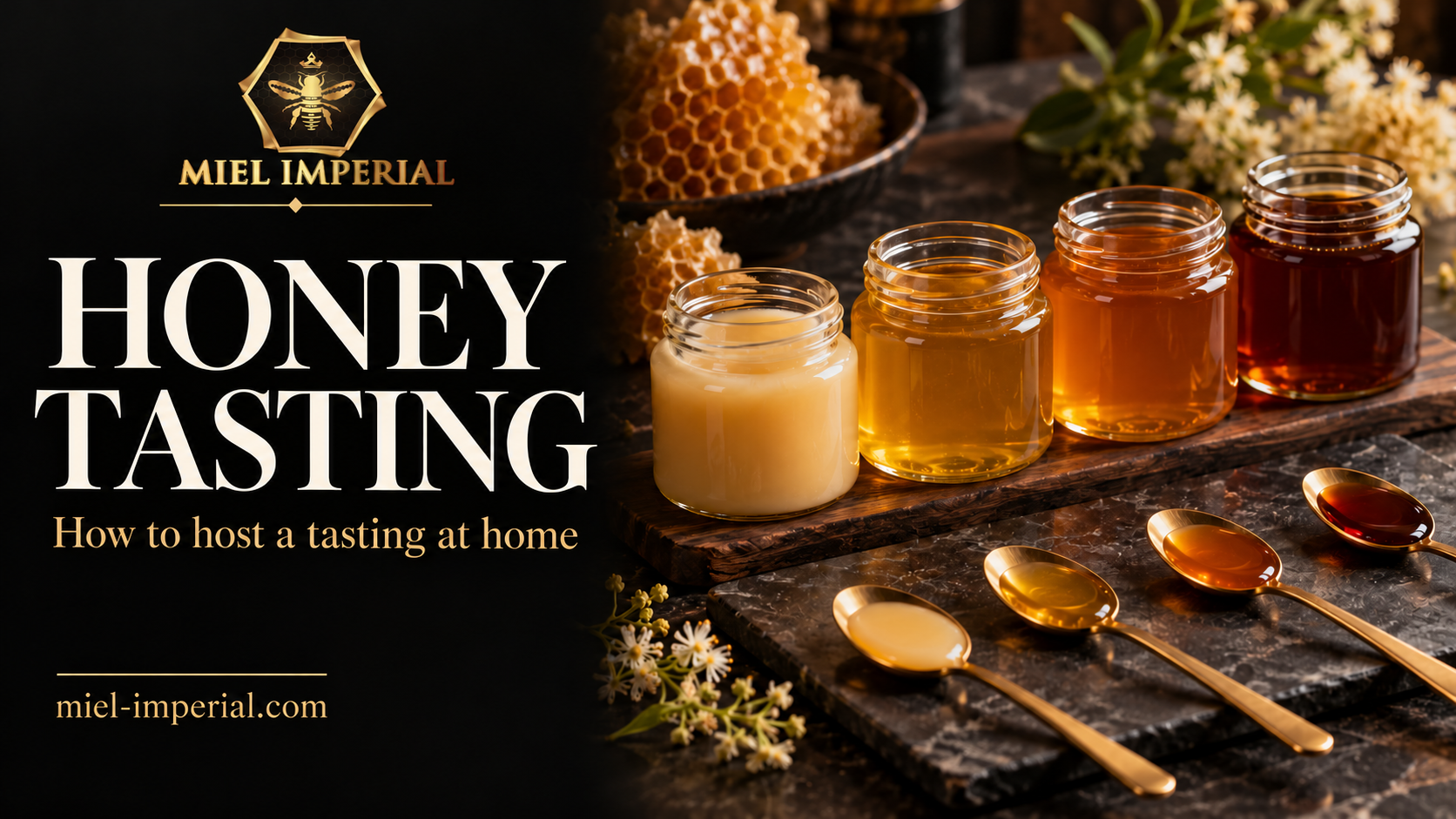
Build a clear progression: pale and delicate, floral, warm amber, then dark or woody. Contrasts in botanical origin, colour and texture make the tasting more rewarding.
- Mild: delicate, creamy or lightly vanilla-like.
- Floral: blossom, fresh fruit or citrus notes.
- Amber: rounded, malty or caramel-like.
- Intense: woody, spicy and persistent.
Colour is only a visual clue; on its own it proves neither quality nor authenticity.
In what order should you taste honey?
- Start with the palest, mildest honey.
- Continue with floral and fruity profiles.
- Move on to rounded amber honeys.
- Finish with dark, woody or spicy samples.
Sip water and eat a small piece of neutral bread between samples. Wait a minute when a honey has a particularly long finish.
How do you complete a sensory scorecard?
Serve about half a teaspoon. Observe the colour, smell gently and let the honey melt on the tongue for a few seconds.
| Criterion | What to notice | Score |
|---|---|---|
| Appearance | Pale, amber, dark, glossy or opaque | /5 |
| Aroma | Floral, fruity, woody or spicy | /5 |
| Palate | Mild, lively, creamy, grainy or powerful | /5 |
| Finish | Short, rounded or persistent | /5 |
How can you compare without bias?
Number the jars and cover the labels for a blind tasting. Each guest records impressions silently before the group discusses them. This reduces the influence of price, origin and other tasters.
A score is not a quality verdict
The card mainly expresses personal preference. A powerful honey may be excellent even when a milder profile receives more votes.
How do you build a honey tasting set?
A successful honey tasting set prioritises variety. Four small, clearly differentiated jars are more educational than a large group of similar products.
- Vary origins and intensity levels.
- Include at least two different textures.
- Keep origin details hidden until the end.
- Read each product page before serving.
Explore the Miel Impérial honey selection.
Frequently asked questions about honey tasting
How many honeys should you serve?
Four provide enough contrast without palate fatigue. Beginners should stay below six.
Can crystallised honey be tasted?
Yes. Crystallisation is a texture characteristic that can be described and scored.
Should honey be warmed?
No. Serve every jar at room temperature for a fair comparison.
What should be served alongside?
Water and neutral bread are enough. Try cheese or fruit only after the pure evaluation.
Sources and guidance
This method follows general sensory-analysis principles: comparable samples, controlled order, descriptive vocabulary and individual scoring. Check product-specific information on each product page and label.
FAO · Honey: composition and characteristics
Build your Miel Impérial tasting
Choose four complementary origins and textures, then compare them with your sensory scorecard.