

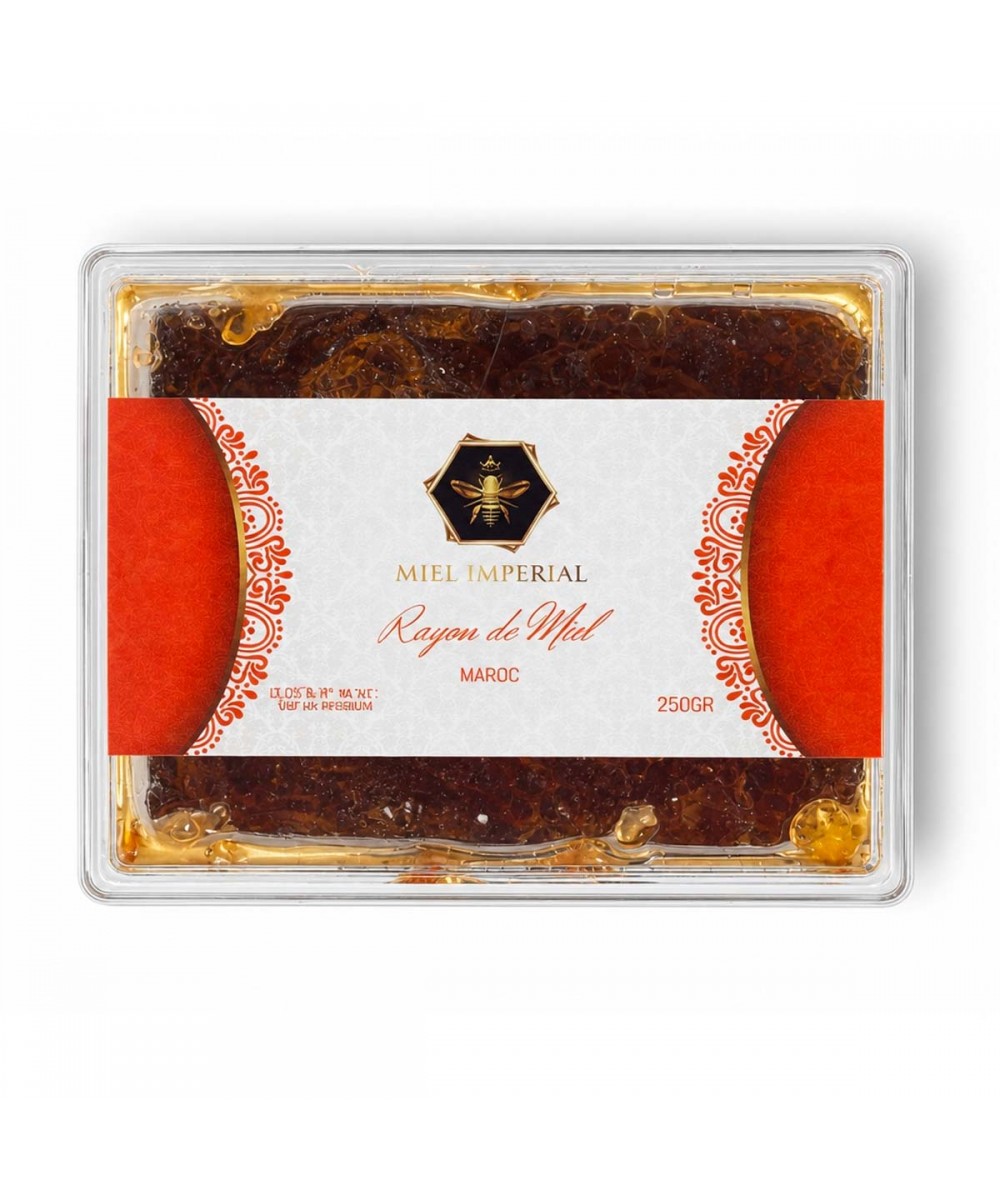

The 250g Moroccan Honeycomb is honey in its purest form: a piece of comb cut directly from the hive frame, with the honey still sealed inside the wax cells capped by the bees. Neither extracted, filtered nor heated, this honeycomb preserves its pollen, natural aromas and original texture exactly as produced by the bees. Harvested from Morocco's rich floral landscapes, it offers an authentic tasting experience just as nature intended.
Honeycomb (also known as comb honey) is a section of the natural hexagonal wax structure built by honeybees. Once the honey reaches full maturity, the bees seal each cell with a thin layer of wax. This natural capping process guarantees fully ripened honey with a low moisture content. The comb is then carefully cut and packaged without undergoing any further processing.
Unlike jarred honey, which is extracted by centrifugation and then filtered, honeycomb undergoes no processing whatsoever:
Morocco benefits from exceptional botanical diversity: thyme and rosemary from the Atlas Mountains, orange blossoms from the Souss Valley, eucalyptus from the Gharb region, wild lavender and many aromatic plants growing across the country's plateaus. This floral richness gives Moroccan blossom honeys a complex aromatic profile combining floral, warm and slightly herbal notes that clearly distinguish them from European wildflower honeys.
This 250g honeycomb comes from Moroccan apiaries that respect the natural rhythm of the bees: harvesting only when the honey is fully mature, with fully capped cells, followed by careful hand-cutting and packaging in a protective tray.
Eating honeycomb is a unique sensory experience. At the first bite, the wax cells burst open and release liquid honey that is even more aromatic than jarred honey because it has never been exposed to air or heat. The thin edible beeswax provides a light chewy texture, similar to natural chewing gum, extending the tasting experience.
This Moroccan blossom honey offers a soft and fruity opening, rich floral notes and a warm, slightly woody finish characteristic of southern Moroccan nectars.
The good news is that the entire honeycomb is edible, including the beeswax, which naturally contains traces of propolis. Here are some of the best ways to enjoy it:
| Criteria | Honeycomb | Jarred Honey |
|---|---|---|
| Processing | None (raw, unextracted) | Extracted, filtered and sometimes heated |
| Pollen & propolis | Fully preserved | Partially removed during filtration |
| Aroma | Completely preserved | Slightly reduced |
| Authenticity | Maximum (natural comb structure) | Depends on traceability |
| Tasting experience | Honey and edible beeswax | Traditional liquid honey |
Honeycomb should be stored at room temperature (ideally between 15°C and 22°C), away from light and humidity, in its sealed protective tray. Refrigeration is not recommended, as it hardens the beeswax and accelerates crystallisation. Like all raw honey, honeycomb may naturally crystallise over time. This is a sign of quality rather than deterioration. When properly stored, honeycomb can be kept for several years.
Yes. Beeswax is completely edible and naturally contains traces of propolis. You may swallow it or chew it like chewing gum before discarding it, according to your preference.
Producing honeycomb requires considerably more work from both the bees, which must rebuild the wax after each harvest, and the beekeeper, who carefully cuts and packages each comb by hand. It is also one of the rarest and most sought-after forms of honey.
Yes, generally from around 3 years old if chewing the wax. Like all honey, it should never be given to infants under 12 months of age.
For several years when stored at room temperature away from light and moisture. Natural crystallisation does not affect its flavour or quality.
The hexagonal comb itself is proof of authenticity, as only bees can build this natural structure. Fully capped cells also indicate that the honey was harvested only once it had fully matured.
Order your 250g Moroccan Honeycomb from Miel Impérial and receive it carefully protected in its tray. You may also explore our complete selection of Moroccan Honeys, including thyme honey, euphorbia (daghmous) honey, orange blossom honey and many other carefully selected varieties chosen for their origin and distinctive character.