


The Dadant hive: the essentials for beekeepers
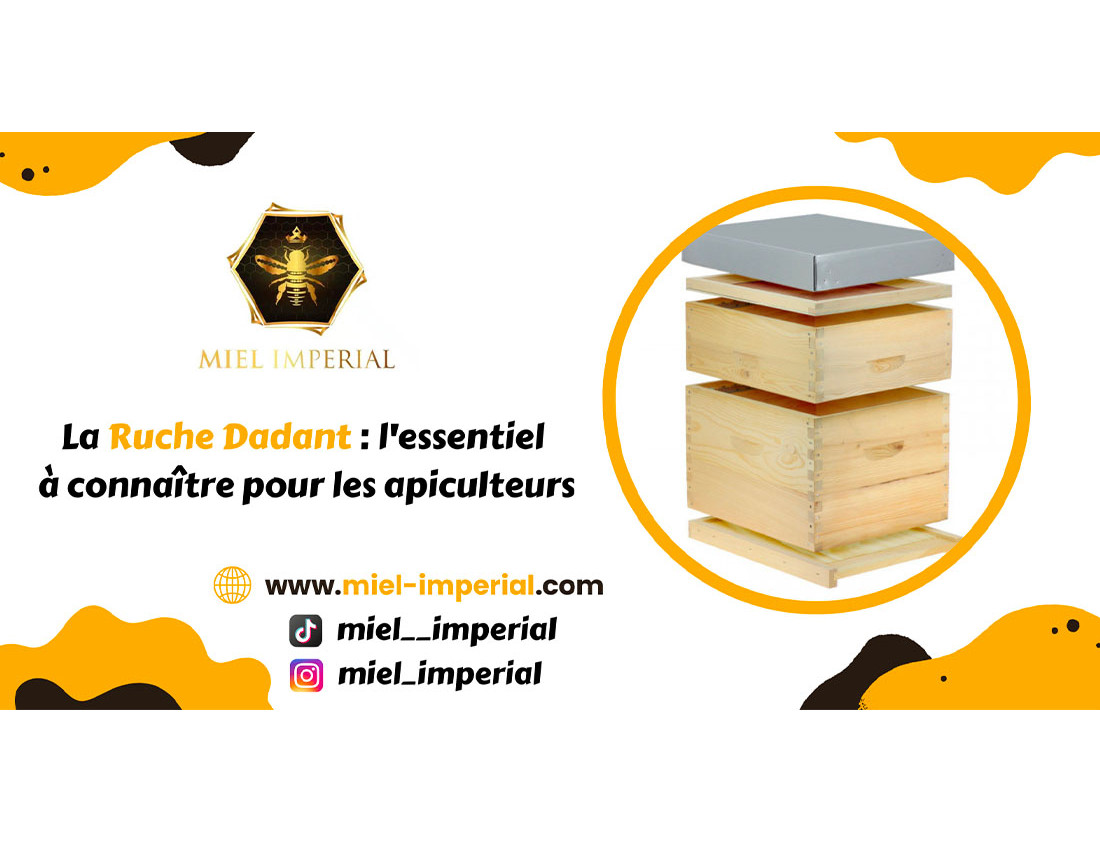
The fascinating world of beekeeping is made up of various types of hive, each with its own specific features. Among them, the Dadant hive is one of the most popular with experts and amateurs alike. This model's main appeal lies in its bee-friendly design, and its ease of use and maintenance for beekeepers.
Origin and history of the Dadant hive
The Dadant hive was invented in 1863 by Charles Dadant, a French beekeeper who immigrated to the USA in the mid-19th century. It was strongly inspired by the famous Langstroth hive invented a few years earlier, considered revolutionary at the time due to the concept of bee space between frames. However, it differs slightly in its dimensions and capacity to accommodate colonies of bees.
Since its invention, this hive has undergone several versions and improvements, including the introduction of the Dadant-Blatt hive, which is now very popular in Europe. Although there are a number of different hive models, such as the Warré, Voirnot or Layens, the Dadant hive is still preferred by many beekeepers for its practical, versatile design.
Dadant hive features
Design and dimensions
The main feature of the Dadant hive is its design with two distinct compartments: the body for the brood and the supers for the honey reserves. This gives the beekeeper easy access to resources without disturbing the bees. Mobile frames are another essential aspect of this hive, offering the possibility of moving elements as required.
In terms of dimensions, the Dadant hive generally has 10 frames in the body, each measuring approximately 45 cm high by 38 cm wide. The beehive can hold 9 to 10 frames. However, there are smaller or larger models, such as the Dadant-Blatt hive with 12 frames or the Dadant 6-frame hive, often used as breeding hives or beehives.
Benefits for bees
Bees greatly appreciate the space offered by Dadant hives, as it favors their organization and development. The wide frames available accentuate the aesthetic appeal of their construction, while ensuring good ventilation, essential for colony survival. What's more, the separation between the body and the beehive allows foragers to store their honey while preserving the brood.
Benefits of the Dadant hive for beekeepers
One of the main reasons why beekeepers love the Dadant hive is undoubtedly its ease of handling, made possible by the movable frames and modularity of the unit. This makes it easier to monitor colony development, carry out health checks or collect honey without stressing the bees.
Also highly appreciated for its high production capacity, it facilitates the harvesting of large quantities of honey. Finally, the Dadant hive excels in its versatility: whether for producing honey, rearing queens or acquiring swarms, this model adapts to all types of beekeeping projects.
Choosing between the different Dadant hive ranges
With so much variety on the market, it's important to determine exactly which model is best suited to the beekeeper's objectives. Here are a few criteria to consider:
- Number of frames: depending on whether you prefer size, maneuverability or honey production, opt for a 6, 10 or 12 frame model.
- Material: wood, expanded polystyrene or plastic, each material has its advantages and disadvantages in terms of insulation, durability and ease of maintenance.
- Planned location: the choice between a free-standing or ground-mounted Dadant hive will depend on the terrain where you intend to install your hives and the environmental constraints of your region.
Whichever model you choose, it's important to pay close attention to manufacturing quality to guarantee a safe and comfortable habitat for your bees. In short, choosing a Dadant hive means opting for a tried-and-tested system appreciated by generations of beekeepers, whose performance has been proven time and again.
In Same Category
- How to Care for Your Skin from Within with Natural Active Ingredients?
- Honey pastries and the importance of choosing the right mold
- National plan to combat the Asian hornet: challenges, measures and stakeholders involved
- Dattes Ajwa : recettes simples sucrées et salées
- Huile de nigelle & miel de nigelle : synergies ou redondances ?