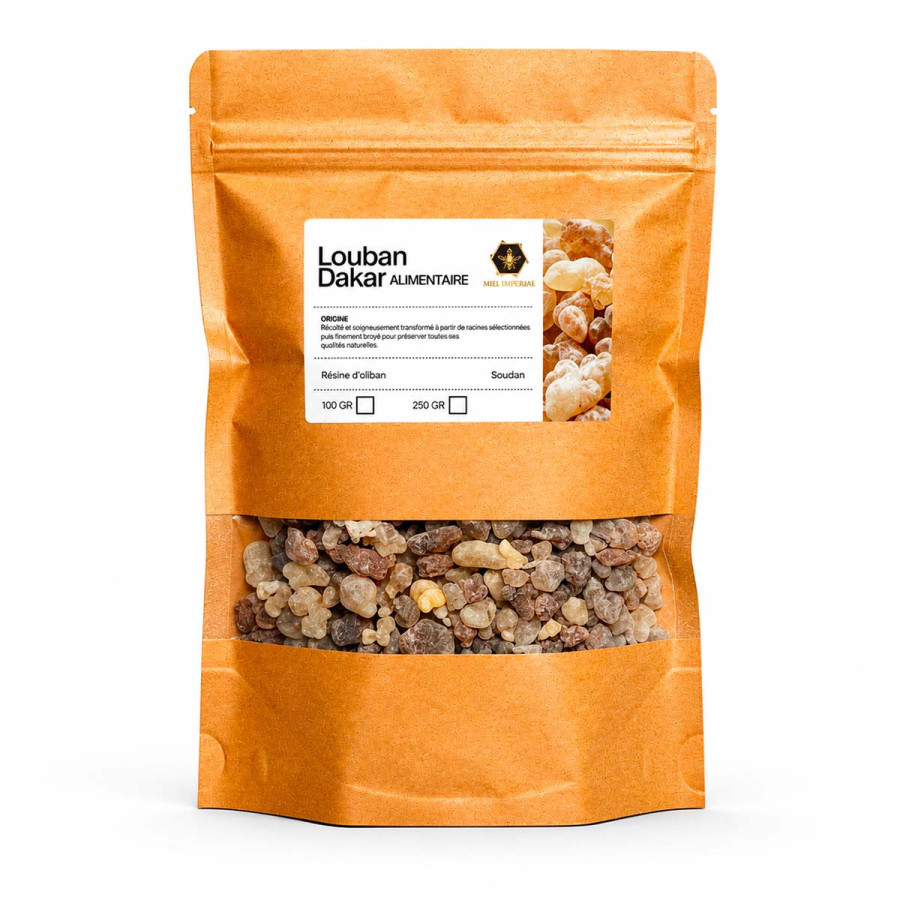
A Miel Impérial Selection
Food-Grade Louban Dakar - 100 g or 250 g
Louban Dakar is a food-grade frankincense resin, harvested in Sudan. These small translucent tears, amber to whitish, are the dried sap of a tree of the Boswellia genus. Very popular in West Africa and the Arab world, it is traditionally chewed like gum or infused in water. Available in a 100 g or 250 g bag.
Miel Impérial Louban Dakar: frankincense resin from Sudan
• Miel Impérial Louban Dakar is a food-grade frankincense resin of Sudanese origin, offered in a 100 g or 250 g bag.
• Frankincense is the dried resin of trees of the Boswellia genus, harvested by cutting the bark and left to harden in the air.
• The tears are translucent, amber to whitish in colour, with a characteristic woody, balsamic fragrance.
• This resin is traditionally chewed like gum or infused in water, following the customs of West Africa and the Arab world.
• It is a food-grade resin: keep it dry, away from heat and light.
100 g or 250 g
two bag sizes
Origin Sudan
stated on the label
Food grade
frankincense resin
Chew or infuse
traditional uses
What is frankincense?
Frankincense, also called olibanum, is the resin produced by trees of the Boswellia genus, which grow in the arid zones of the Horn of Africa and the Arabian Peninsula. Harvesters make an incision in the bark: the tree then releases a milky sap that slowly hardens on contact with air.
These solidified drops, called tears, are then detached by hand and sorted. Their colour ranges from amber to whitish depending on the species and the harvest, and their woody, balsamic fragrance is instantly recognisable.
Louban, a resin of a thousand names
In Arabic the resin is called louban (لبان), a term found throughout the Arabic-speaking world and as far as West Africa, where Louban Dakar is especially popular. In English it is frankincense or olibanum.
Its trade is one of the oldest in the world: the incense route linked southern Arabia and the Horn of Africa to the Mediterranean long before our era. Sudan, where this resin comes from, is among the historic production areas.
How to use Louban Dakar
Chewed
The most widespread use. Take a small tear, let it soften in the mouth for a moment, then chew it like a natural gum. It turns white and supple as you chew.
As louban water
Soak a few tears in a glass or bottle of water for several hours or overnight. The water takes on a delicate woody fragrance. Strain before drinking.
With honey
A natural pairing: the woody, slightly bitter note of the resin answers the sweetness of a characterful honey.
The taste
Fresh, woody, slightly lemony and a little bitter at the start of chewing. The taste softens as the resin becomes supple.
Choosing your size
The 100 g bag suits discovering the resin or occasional use. The 250 g bag is aimed at regulars and at those who often prepare louban water: it offers better value by weight and avoids frequent reordering. In both cases the resin keeps for a long time if it stays dry.
Precautions
• Product to be chewed: do not swallow the pieces of resin. Supervise children while chewing, because of the choking risk.
• Not recommended for young children or for pregnant and breastfeeding women without medical advice.
• If you have a known allergy to plant resins, try a very small amount first.
• If you are on any medical treatment, ask your doctor or pharmacist before regular consumption.
• This product is a food-grade resin. It replaces neither a varied, balanced diet, nor medical treatment, nor the advice of a healthcare professional.
Storage
Keep the resin dry, bag tightly closed or in an airtight jar, away from heat, light and humidity. Heat softens the tears and makes them stick together: avoid leaving the bag near a heat source. Keep out of reach of young children.
FAQ - Louban Dakar
What is Louban Dakar?
It is a food-grade frankincense resin, here of Sudanese origin. The word louban is the Arabic name for this resin, which is very popular in West Africa under this name.
Louban, olibanum, frankincense: are they the same?
Yes. It is the resin from trees of the Boswellia genus. It is called louban in Arabic, oliban or encens in French, frankincense or olibanum in English.
How is Louban chewed?
Take a small tear, let it soften in the mouth for a moment, then chew it like gum. It whitens and becomes supple as you chew. Do not swallow it.
How do you prepare louban water?
Soak a few tears in a bottle of water for several hours or overnight, then strain before drinking. The water takes on a delicate woody fragrance.
What does frankincense resin taste like?
Fresh and woody, with a slightly lemony note and a noticeable bitterness at the start of chewing, which then fades.
100 g or 250 g: which size to choose?
The 100 g bag to discover it or for occasional use, the 250 g bag for regular use, with better value by weight.
How should Louban Dakar be stored?
Dry, bag tightly closed or in an airtight jar, away from heat and humidity. Heat makes the tears stick together.
The resin of the incense route
Food-grade Louban Dakar · frankincense resin from Sudan · 100 g or 250 g bag. A Miel Impérial selection.